Thermal behavior and efficiency of a MD-BTES system measured using a distributed geothermal response test
Researchers from the University of Darmstadt have done research into the thermal behavior and efficiency of a medium-deep borehole thermal energy storage (MD-BTES) system using a distributed geothermal response test (dGRT) on a 750 m deep coaxial borehole. The goal was to better understand subsurface thermal properties, borehole performance, and internal heat losses—key factors for optimizing large-scale seasonal heat storage.
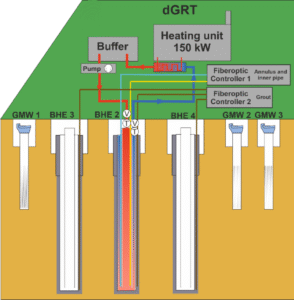
Using fiber-optic distributed temperature sensing (DTS) in the inner pipe, annulus, and grout, the authors obtained depth-resolved temperature data during a 42-day high-power heating test (≈150 kW). This enabled both conventional GRT analysis and a depth-resolved dGRT evaluation.
They found that thermal conductivity varies significantly with depth, reflecting geological transitions from one type of subsurface material to another. Furthermore, borehole thermal resistance decreases steadily with depth, indicating improved thermal coupling in deeper, more homogeneous rock.
Schematic of the test setup of the dGRT measurments
When optimizing their testing methods, the researchers found that DTS-based “true mean” fluid temperatures yield more accurate GRT results than conventional inlet–outlet averages, which tend to overestimate borehole resistance. To check their findings, they ran numerical simulations (FEFLOW) based on the GRT results. Those match measured the temperatures closely, especially when depth-resolved data are used.
They also found some causes for efficiency loss. Significant thermal short-circuiting occurs within the coaxial borehole: roughly 50 % of injected heat is lost from the inner pipe to the annulus, with nearly half of that loss concentrated at insulation clearances in the inner pipe. Additionally, low-conductivity grout in the upper borehole section effectively limits heat loss to shallow groundwater, but internal pipe losses reduce overall efficiency at high operating temperatures.
Overall, the study demonstrates that dGRT provides high-quality, depth-resolved thermal property data for medium-deep systems, filling a major experimental gap. The results highlight both the feasibility of MD-BTES for seasonal heat storage and the importance of optimizing borehole insulation design, flow rates, and operating temperatures to minimize internal heat losses in future installations.
If you want to read the complete paper about this research or other papers from the PUSH-IT consortium, you can find it here.
PUSH-IT is a project funded by the European Union’s Horizon Europe research and innovation programme under grant agreement No 101096566. Funded by the European Union. Views and opinions expressed are however those of the author(s) only and do not necessarily reflect those of the European Union. Neither the European Union nor the granting authority can be held responsible for them.