Darmstadt site connects to District Heating Network of TU Darmstadt Campus
A few weeks ago, a very important achievement was reached at the site in Darmstadt. The Medium-Deep Borehole Thermal Energy Storage (MD-BTES) system was connected to the heating network of the TU Darmstadt Campus. We asked Markus Schedel about the process that lead to this achievement and the steps going forward.
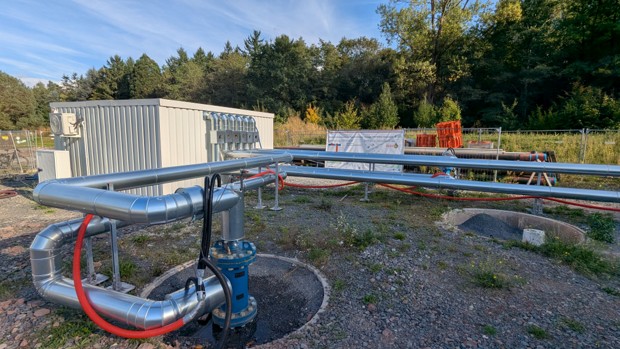
The connection of the Borehole to the hydraulic container
What has been achieved exactly?
The commissioning of our MD-BTES with connection to the local heating network at the TU Darmstadt Lichtwiese Campus. At the moment we are charging the BTES. That means the system is in full operation. However, this is “only” research operation. For real operation as a complete system, more boreholes would be necessary, but that is not the scope of this project.
What were the challenges you faced before this was possible?
There were a lot of different challenges. Initially, there were longer discussions about where we could connect to the campus grid. This was made more difficult because we had a bigger construction site of a new building complex next to the site and there shouldn’t be any interferences between our construction works and the ones of the building. Lots of meetings were held with different heat pump providers, thermal bedding material suppliers, consultants, the building owner, and the energy contractor to finalize planning. At the end of 2024 and the begin of 2025 the preparations for the tendering begun. Finally, the construction phase was from May to August 2025, where we had to adjust smaller details, such as unforeseen pipes crossing among other issues. Since a part of the connection line was installed with a new approach previously developed at TU Darmstadt, there were some additional challenges there: Unlike the usual method of using pre-insulated composite pipes, this approach considers using simple pipe systems to simplify the installation process. The pipe trench was backfilled with low-thermal conductivity bedding material to thermally insulate the pipes from the surrounding soil.
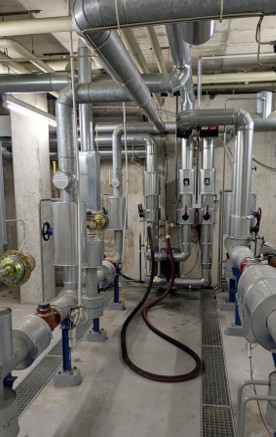
The connection of the MD-BTES system to the Heating Network
What are the next steps to realise?
At the moment we are charging the BTES. That means we are extracting heat from the grid and storing it in the BTES. From December on we will have a heat pump that we will use for the discharging. A controller with a control strategy will be installed in cooperation with Vito (read more about their work here). We will then do various cycles of charging/discharging to test the interaction of the MD-BTES and the grid connection as well as test control strategies.
PUSH-IT is a project funded by the European Union’s Horizon Europe research and innovation programme under grant agreement No 101096566. Funded by the European Union. Views and opinions expressed are however those of the author(s) only and do not necessarily reflect those of the European Union. Neither the European Union nor the granting authority can be held responsible for them.