Mud and well integrity tests performed at TU Delft
At TU Delft, research has been conducted into well design and so called mud and well integrity tests have been performed. We asked Alexis Koulidis, one of the researchers on this subject, what these tests are and how they contribute to achieving the PUSH-IT goals.
What exactly are mud and well integrity tests?
Drilling fluid or mud and well integrity tests are two completely different tests that are both vital to drill and complete a well successfully.
Mud tests are tests of the drilling mud or drilling fluid. During drilling (due to positive differential pressure), the drilling fluid has the tendency to flow into the formation and the solid particles (additives) forma filter cake on the wellbore wall and assist in the stability of the well. The filtercake reduces the hydraulic conductivity in the near wellbore region, and you want to be able to remove the filter cake and recover the hydraulic conductivity prior to completing the well.
To provide these properties, various additives are added to the fluid. The mud tests provide an insight in which of these additives are the best to use. For mud tests, the objective is to identify the optimum drilling fluid that enhances hole strength, wellbore strengthening, and makes it possible to remove the filter cake afterwards with different well development practices.
In well integrity tests, the annular materials are tested on a number of properties. Annular materials are the materials that are used around the casing in the well to hold the casing in place, act as a barrier and prevent crossflow between formations.
They also need to insulate the casing so that the heat is saved as much as possible and not radiated out to the ground around the pipe. Examples of annular materials are cement, grout and various types of clay pellets . Because these wells should work for years, the annular material should keep integrity over a long period of time. It also should be able to handle thermal cycling, especially when the temperature differences are as high as with an HT-ATES system.
The annular materials are tested on a thermal cycling apparatus that recreates the thermal cycling (similar to HT-ATES) and measures the hydraulic conductivity over time. In that way, we are able to evaluate the sealing performance. For well integrity tests the objective is to ensure that the annular material can provide sealing capacity over long term thermal cycling loading. When evaluating completion and annular materials, well integrity is a key factor, but heat losses are equally important. We want to avoid annular materials that have high thermal conductivity, as they lead to greater energy losses.
What is the process of performing those tests?
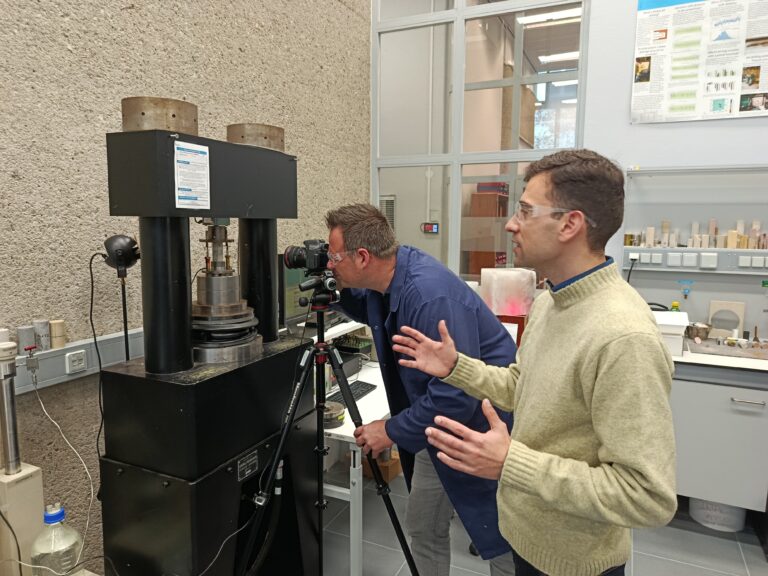
When performing the mud tests, ensure that everything in the lab is similar to the field conditions. For the drilling fluids, we try to simulate downhole conditions as closely as possible, using the same type of sand and pressures. We inject the drilling fluid and observe how the hydraulic conductivity decreases over time. After that, we take a subsample from the test to examine at a much higher resolution and observe how the particles clog the pores.
We have also designed an additional setup to conduct different well development methods. Then, we monitor how the hydraulic conductivity recovers. That way, we can see if the filter cake is removed successfully.
Annular material tests are very complex. The material needs to be placed around the tube (inside the thermal cycling apparatus) for 28 days to be cured. After that, we can apply the thermal cycling. Then, we perform an injectivity test to check the permeability. That way, we can see if there is space between the casing and the annular material.
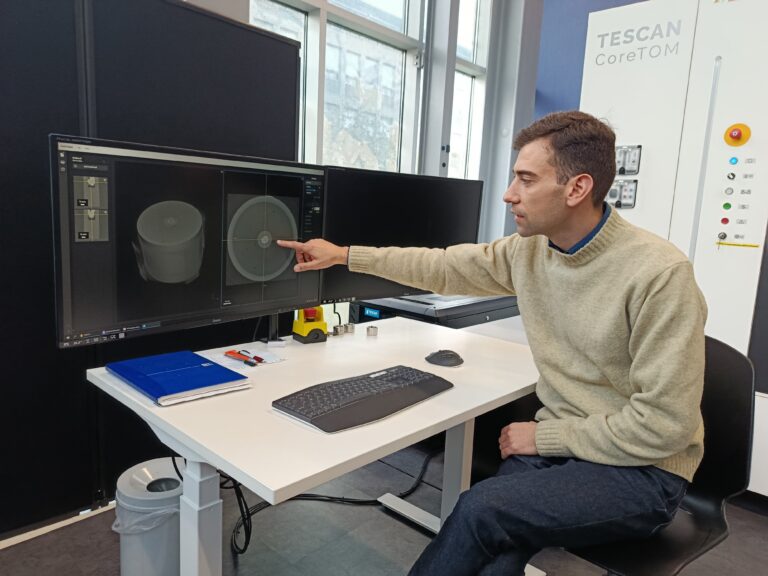
We use micro-CT scanning to observe whether there is any additional space between the casing and the annular material. With image processing, we can measure the size of the gap, which is called micro-annulus. We perform these tests using different materials such as grouts, clays, and cement. If there is a compromise in well integrity, then there is a preferential flow path for water to flow.
What are the results of the tests you have performed?
We have identified the optimum drilling fluid design for wellbore strengthening and we are currently working on the best well development method.
For the annular materials, we observed that materials with elastic behavior provide long-term well integrity compared to those that deform plastically under thermal cycling. The material of the casing is also very important, as it results in different thermal stress conditions. However, there are other considerations when choosing annular materials — factors such as cost, the mixing process, and the method of pumping the material into the subsurface must also be considered.
Cement has generally been proven to be a viable option, but we also wanted to investigate materials used in other types of wells to determine whether they are suitable for high-temperature applications. Grouts contain more bentonite, which results in lower thermal conductivity and therefore lower heat losses, while clay pellets are easy to install and have low thermal conductivity. In the end, we identified the best annular materials for different types of wells.
This research helps to identify the best drilling fluids and annular materials that can be used at the sites of the PUSH-IT project, but also on other sites in the future.
What is the next step to research?
In the research about the drilling fluids we are currently using a new apparatus to test well development methods for various drilling fluids.
For the annular materials the research is finished. We presented the results in the European Geothermal Congress 2025, and we are currently working on a journal publication. The next step could be testing different casing materials in combination with the annular materials.
PUSH-IT is a project funded by the European Union’s Horizon Europe research and innovation programme under grant agreement No 101096566.
Funded by the European Union. Views and opinions expressed are however those of the author(s) only and do not necessarily reflect those of the European Union. Neither the European Union nor the granting authority can be held responsible for them.