What is Open Science?
Practicing Open Science is an important principle in the PUSH-IT project in order to make best use of the project results during and after the project. The use and the development of open standards and also practicing open science is important to maximize the use of the results during and after the project lifespan. Open Science assures that the (intermediate) results of the project are findable, accessible, interoperable and reusable by others. This is important for the scalability of the project results, the uptake of the results by a wide range of stakeholders and the maximization of the project’s impact.
Why does Open Science exist?
In recent years, traditional research has encountered several problems. There is a so-called “reproducibility crisis” for example, which means that there is quite a lot of research that can not be checked by other researchers, because the research methodology or data is not freely available. This harms the reliability of scientific research.
This reproducibility crisis is at least partly due to limited access to publications, which in turn causes overreliance on journal metrics. The limited access to scientific data and publications also is a barrier for collaboration.
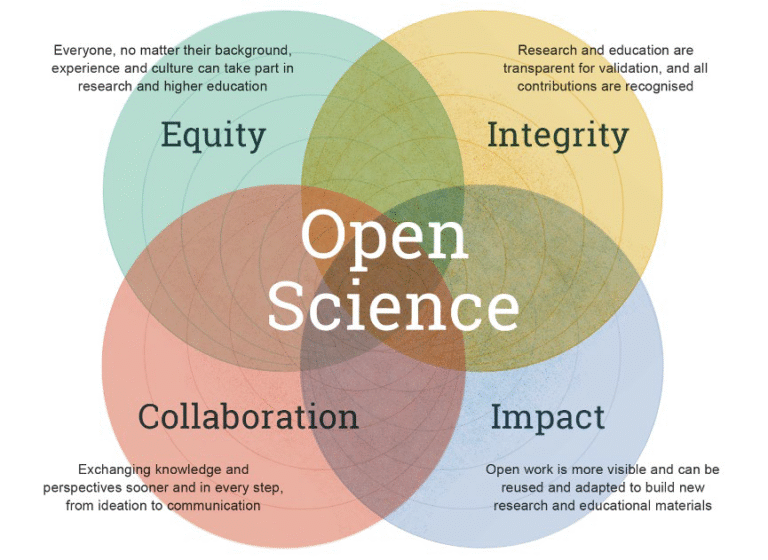
Open science aims to be more transparent, promote collaboration and increase accessibility. This will improve the research integrity and reliability.
Open Data: meaning and limits
Open data means data that can be freely used, reused, and shared. However, openness is not absolute. Data sharing may be restricted by personal data protection, intellectual property rights, commercial confidentiality, environmental protection (e.g., rare species locations) or public authority confidentiality. Open Science therefore always requires balancing transparency with responsibility.
The EU promotes reuse of publicly funded research and public sector data to stimulate innovation and economic value. To that goal, it has published the Open Data Directive, which promotes the use of open data. It states that publicly funded research data should be open by default; data should be reusable and usually free of charge and that data must follow FAIR principles.
Those FAIR principles state that research data should be:
- Findable → easy to locate with metadata
- Accessible → obtainable under clear conditions
- Interoperable → usable across systems
- Reusable → well-described and licensed
Researchers are encouraged to evaluate whether their own data meets these criteria.
High-Value Datasets (HVD)
Some datasets have exceptional public benefit and must follow stricter openness rules. There are six areas that are considered high value, namely:
- Geospatial
- Earth observation & environment
- Meteorology
- Statistics
- Company ownership
- Mobility
These datasets are required to be published in a machine-readable format, available via APIs or bulk download, free of charge and using open licences like CC0 or CC BY 4.0. This last requirement is because those licenses determine how data can be reused. Open licences enable redistribution, modification and reuse without restrictive barriers. Therefore, choosing the correct licence is part of responsible Open Science.
PUSH-IT wants to contribute to the accessibility and reliability of science and therefore always makes their research as findable, accessible, interoperable and reusable as possible. You can find the papers published by consortium members here. Other deliverables you can find in the repository.

PUSH-IT is a project funded by the European Union’s Horizon Europe research and innovation programme under grant agreement No 101096566.
Funded by the European Union. Views and opinions expressed are however those of the author(s) only and do not necessarily reflect those of the European Union. Neither the European Union nor the granting authority can be held responsible for them.