
New PUSH-IT deliverable on cosimulation finished
A new PUSH-IT deliverable explores how different models can be brought together to simulate the interactions between all different parts of the heating network. But what exactly is cosimulation, and why is it so useful for underground thermal energy storage? We spoke to deliverable author Ergin Kükrer to find out and to hear about the challenges the researchers faced along the way.
What is co-simulation?
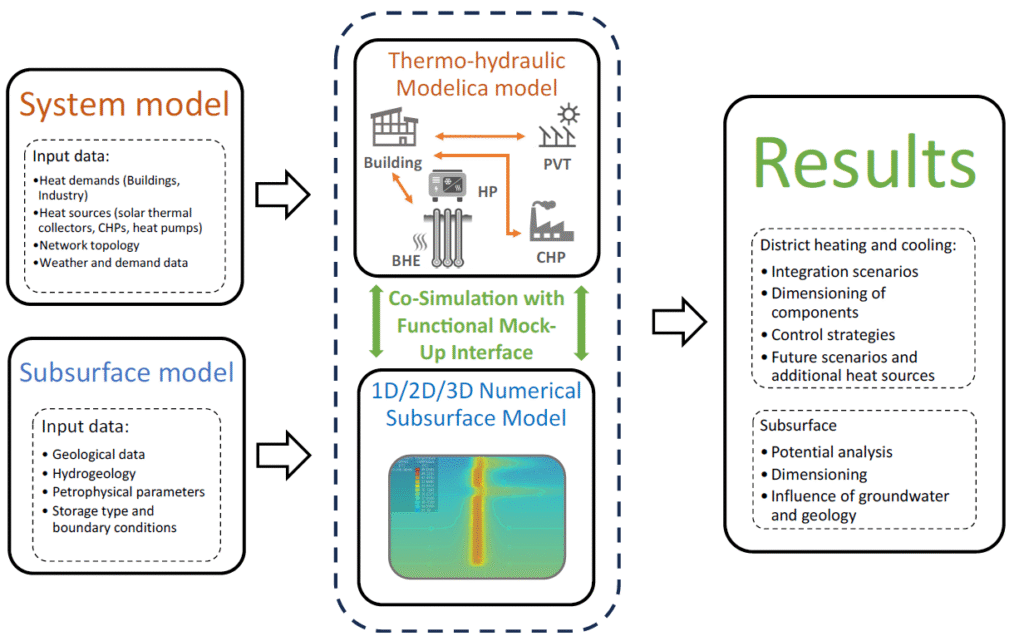
Co-simulation is an approach in which different components of an energy system are simulated using separate, specialised models, while they exchange information with each other dynamically during the simulation. In our case, this allows us to combine models of the underground thermal storage with models of above-ground energy systems, such as heat pumps, buildings, district heating networks and other energy sources.
What are, in your opinion, the highlights of the research you have done?
For me, an important outcome is that we can study the underground storage as part of the complete energy system rather than as an isolated component. The simulations allow us to see how operational decisions at the surface, such as heat pump operation, charging/discharging temperatures and flow rates, influence the behaviour of the storage over longer periods.
At the same time, changes in storage conditions affect how the surface system can operate and meet the energy demand. This gives us a more holistic view of system performance and provides a solid foundation for developing and implementing effective control strategies.
Why is it important this research is done?
Underground thermal storage and the surface energy system strongly influence each other. For example, the temperatures and flow rates used to charge or discharge a storage system affect its long-term thermal behaviour, while the conditions available from the storage affect the operation of heat pumps and the amount of energy that can be supplied to the network.
If these systems are simulated separately, many of these interactions need to be simplified or prescribed in advance. However, in reality, these conditions are not necessarily fixed but can change as a result of the interaction between the storage, the surface energy system and demand.
Co-simulation allows both sides to respond dynamically to each other. This makes it possible to investigate more realistic system operation and to evaluate how different designs, operating strategies or control approaches affect the performance of the system as a whole. Long story short: Co-simulation gives us the full picture.

What were the greatest challenges in doing this research?
One of the main challenges was connecting models that were originally developed independently and often work with different timesteps, inputs, outputs and modelling assumptions.
The surface energy system can respond relatively quickly to changes in demand and operating conditions, while the thermal behaviour of underground storage develops over seasons and years. Therefore, another important challenge was to balance sufficient model detail with computational efficiency, particularly for multi-year simulations. Furthermore, the different demo sites have different system layouts and technologies, so the co-simulation approach needs to remain flexible enough to represent these varying configurations.
What was your personal motivation for doing this work?
To make sustainable heating a reality, we cannot just look at the heat source or the users in isolation. We need to understand the entire chain. So, for me, one of the most interesting aspects is the integration between the underground storage and the rest of the energy system. The performance of thermal storage depends strongly on how it is connected to and operated together with the wider surface infrastructure, so studying the storage alone only tells part of the story.
Co-simulation gives us a way to understand these interactions and, importantly, to connect detailed modelling with practical questions about how the integrated system should be operated and controlled.
I also find it particularly valuable that the work is connected to real demonstration sites. This means that the modelling is not only theoretical, but can contribute to a better understanding and improvement of real systems being developed within PUSH-IT.
The full deliverable can be found here.

PUSH-IT is a project funded by the European Union’s Horizon Europe research and innovation programme under grant agreement No 101096566.
Funded by the European Union. Views and opinions expressed are however those of the author(s) only and do not necessarily reflect those of the European Union. Neither the European Union nor the granting authority can be held responsible for them.