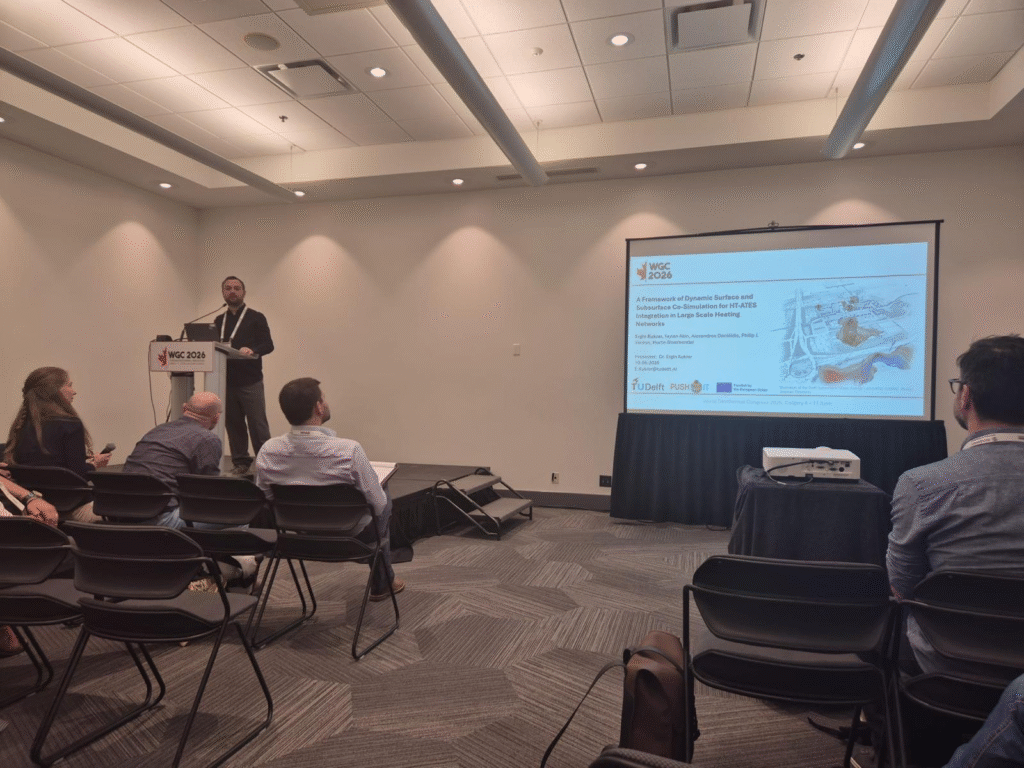
A few weeks ago, several researchers from the PUSH-IT consortium attended and presented at the World Geothermal Congress. One of them was Ergin Kükrer, who talked about cosimulation for HT-ATES systems.
In his presentation, Ergin talked about how managing a heating network with a geothermal source and an HT-ATES system is much more complicated than simply turning equipment on and off. Every hour, the system has to decide where heat should come from. Should it use geothermal heat directly? Should it draw heat from underground storage? Should it store surplus heat for later? Or is the gas boiler temporarily needed?
These decisions depend on a number of constantly changing factors, including:
Outdoor temperature
Heating demand from homes and buildings in the heating network
Water temperatures returning from the heating network
The temperature of the stored heat underground
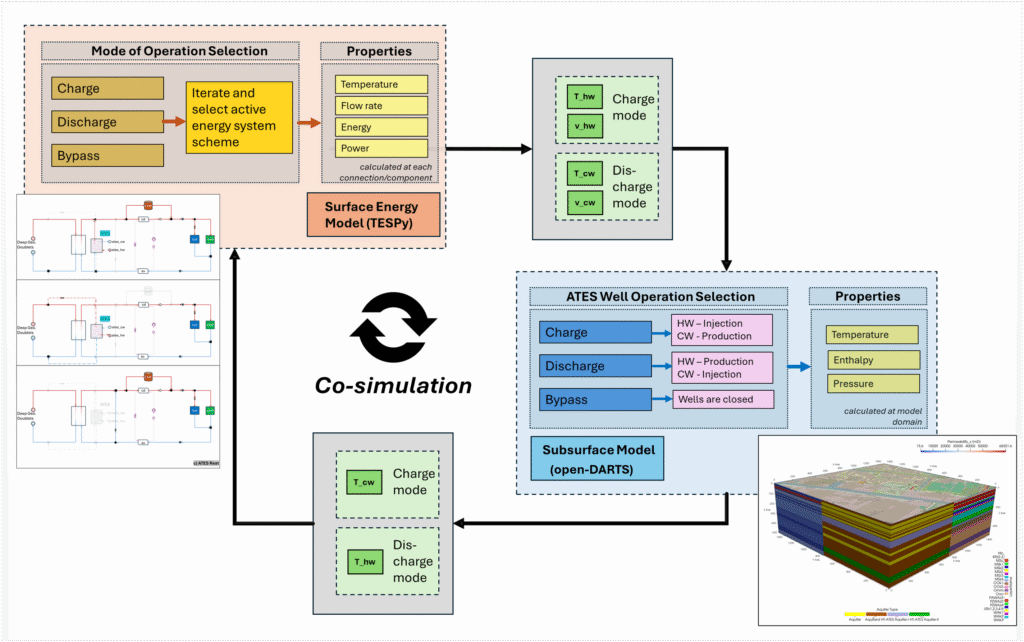
Because all these parts influence one another, Ergin and his colleagues created a digital model that simulates both the underground storage and the surface heating network simultaneously. This “co-simulation” allows them to see how decisions made above ground affect the underground storage and vice versa.
Ergin Kükrer presenting at the World Geothermal Congress
The researchers applied this approach to the geothermal heating network serving Delft University of Technology and part of the city of Delft. Instead of looking at only one component, the model follows the entire system hour by hour over five consecutive years.
This long-term approach is important because underground heat storage changes gradually. Just like charging and discharging a rechargeable battery improves understanding of its performance over time, the underground heat reservoir develops its own stable operating pattern after several years.
The results were encouraging. As the underground storage warmed up over successive years, it became increasingly effective at supplying heat during winter.
After five years:
The amount of heat supplied from underground storage increased by almost 50%.
The need for the natural gas boiler dropped from 13.4 GWh to 7.8 GWh, a reduction of about 42%.
The geothermal wells continued providing a stable renewable heat supply throughout the entire period.
In other words, over time, less and less fossil fuel was needed to meet peak winter demand.
A schematic view of the cosimulation
Many future district heating networks will rely on several renewable heat sources working together. This research shows that success doesn’t depend only on having good geothermal resources. It also depends on operating the entire system intelligently. By continuously monitoring temperatures, heat demand and storage levels, operators can make smarter decisions that maximise renewable energy and minimise fossil-fuel use. The modelling approach developed by the Ergin and his colleagues provides a powerful tool for designing and operating these next-generation heating systems before they are built.
Although this study focused on the Delft geothermal demonstration project, the findings are relevant far beyond the Netherlands. Many cities are exploring geothermal energy, seasonal heat storage and district heating as part of the transition to low-carbon heating. Digital simulation tools like this can help engineers optimise these complex systems, improve efficiency and reduce greenhouse gas emissions.
The study demonstrates that combining geothermal energy with underground seasonal heat storage isn’t just technically feasible, but it can substantially reduce reliance on fossil fuels while making renewable heating systems more flexible and resilient.
This research is also part of the new PUSH-IT deliverable on cosimulation, on which we will report soon.
PUSH-IT is a project funded by the European Union’s Horizon Europe research and innovation programme under grant agreement No 101096566. Funded by the European Union. Views and opinions expressed are however those of the author(s) only and do not necessarily reflect those of the European Union. Neither the European Union nor the granting authority can be held responsible for them.