
New Resource: The PUSH‑IT Engagement Catalogue
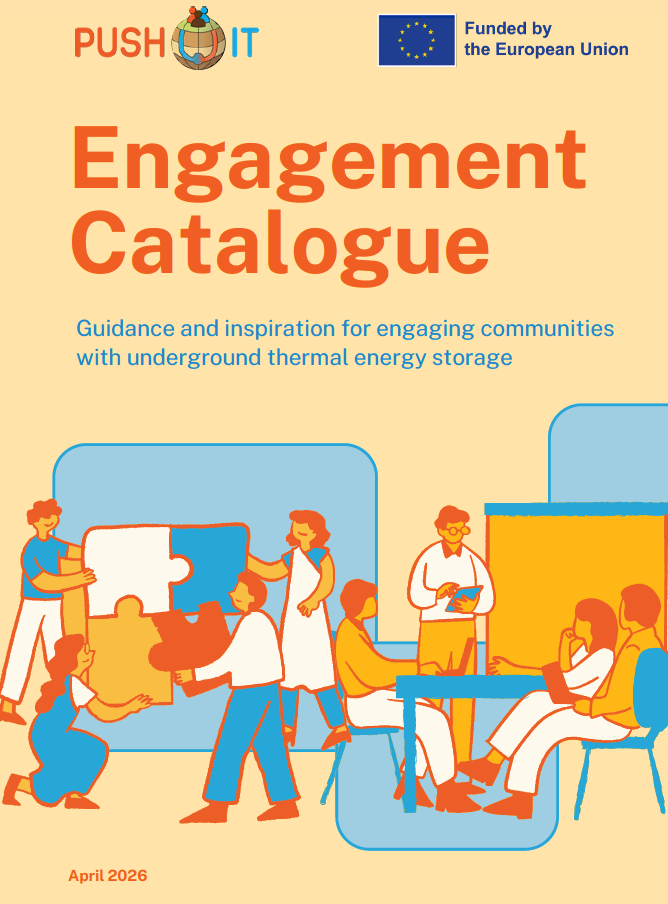
A new resource has been created and added to the PUSH-IT repository: The Engagement Catalogue. Merryn Thomas and her team have worked long and hard on putting it together, so we asked her to explain what it is and what its goal is.
What is the engagement catalogue?
As part of the societal engagement work within PUSH-IT, the Engagement Catalogue was developed as a practical resource to support community engagement around underground thermal energy storage (UTES). It provides an accessible introduction to key considerations for planning engagement – why, who, how, when, and where – alongside practical tips and a wide range of engagement formats. These include informal public events, deliberative workshops, citizen science, creative and arts‑based methods, surveys, and school activities. The catalogue includes 30 hands‑on tools, ranging from participatory mapping exercises to everyday “kitchen science” demonstrations, creative activities, and games designed for diverse audiences.
Who is the engagement catalogue for?
The catalogue is for anyone interested in engaging communities and other stakeholders with underground thermal energy storage, or energy technologies more broadly. With a focus on making difficult-to-see underground environments more tangible, it is particularly relevant to areas such as carbon capture and storage (CCS), geothermal energy, critical minerals extraction, and nuclear waste disposal.
It is likely to be especially useful for project developers, local authorities, researchers and engagement practitioners seeking effective and inclusive ways to work with local communities. We have designed the catalogue so it can be flicked through for inspiration, used as a reference, or a template. There are also lots of useful links to key literatures, other projects and resources.
How did you make the engagement catalogue?
The Catalogue is the result of a collaboration between members of the PUSH-IT consortium and external engagement experts. Co-creation included informal conversations with engagement leads, invited contributions, dedicated catalogue development sessions, and iterative feedback.
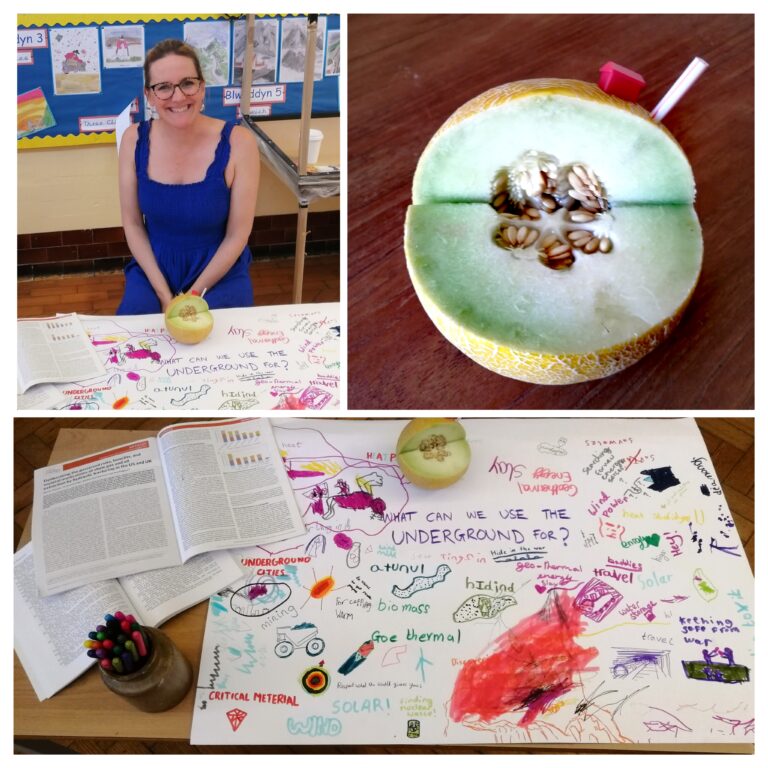
We’d like to sincerely thank everyone who contributed their ideas, experiences, and insights. A list of acknowledgements can be found inside the front cover, and the catalogue is also shaped by countless participants of various engagement events both as part of PUSH-IT and other projects we have been involved with. Some ideas emerged quite by accident. The one-minute-melon (p.55) was the product of a last-minute dash to the supermarket before a school careers fair, while a heat storage experiment became a competition (p.53) after one young participant announced that experiments are ‘boring’.
What have you learned yourself while making the catalogue?
It’s been so much fun collecting, creating and testing the activities in the catalogue, and it’s been an absolute pleasure learning from engagement experts at the forefront of UTES development, as well as the people taking part in engagement activities themselves. The process reinforced just how powerful co‑creation can be, and how many different ways there are to make the underground tangible and meaningful.
What is your personal favourite part of the catalogue?
This is far too difficult to answer! I love Elke’s children’s book (p.50), Veronika’s jelly experiments (p. 52), Jane’s matching pairs (p. 66) and Serge and Jesse’s tips for online engagement (p. 35). I was pleasantly surprised at how useful a melon could be for attracting children to find out about UTES, and at the other end of the scale, participatory mapping (p.43) and the risk/benefit poster task (p.44) are tried-and-tested ways to get some really insightful conversations going with adults.
We hope you find the Catalogue useful and would be very pleased to hear how you apply it in practice.
The flipbook version can be found here.
To download the high resolution version, click here.
For further information, please contact m.j.thomas@exeter.ac.uk.

PUSH-IT is a project funded by the European Union’s Horizon Europe research and innovation programme under grant agreement No 101096566.
Funded by the European Union. Views and opinions expressed are however those of the author(s) only and do not necessarily reflect those of the European Union. Neither the European Union nor the granting authority can be held responsible for them.