PUSH-IT consortium meets for General Assembly in Cornwall
Last week, the PUSH-IT General Assembly was held in theNational Maritime Museum Cornwall in Falmouth, UK. The goal is to reflect on the progress of all the different aspects of the project and of course reconnect with partners from across Europe.It was great to see all the passion there is for bringing the technology around UTES to a higher level.
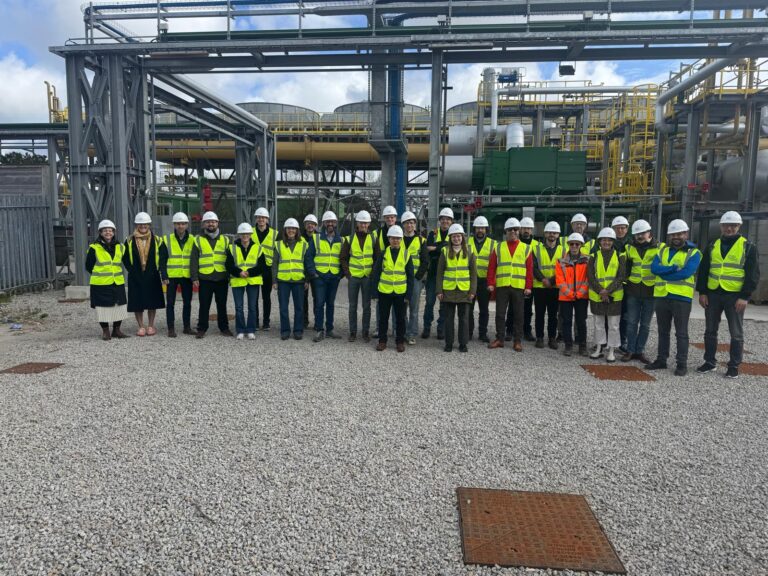
A group photo of all the attendants of the General Assembly
Updates were presented from all the demonstrator and follower sites, as well as the research into societal engagement and enabling technologies. Every site is making good progress, although some sites also experience challenges. Al lot of work has already been done and we expect that our key deliverables and milestones will be met by the end of this year.
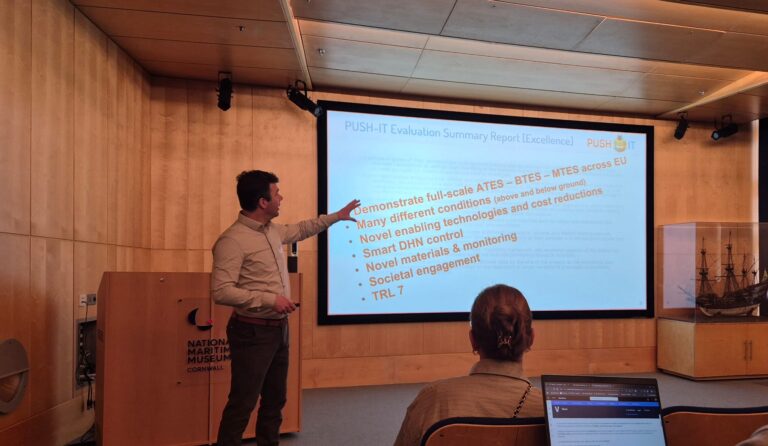
Martin Bloemendal presenting at the general assembly
There were a few interesting specific updates that were given, for instance about the smart control systems that are to be implemented. In Darmstadt, the team is working hard to measure smart data from the connection to the district heating network of the TU Darmstadt campus, while taking into account the strict safety regulations of IT and Energy Departments of the TU. This proves to be an interesting test case for other sites as well.
The team working on societal engagement presented their preliminary findings from the large survey they performed in all countries that PUSH-IT is active. They measured the knowledge there is of UTES and the willingness there is to implement it in the respondents’ local area.
In Delft and Utrecht, two new researchers, Robin Willingshofer and Peter Mock, are going to investigate how to bring down the levelised cost of energy (LCOE) for storage and the heating system. They will expand on the work done by David Geerts.
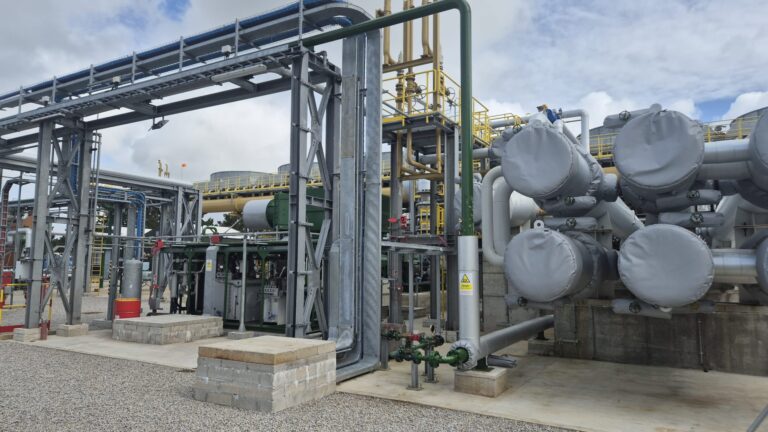
The Geothermal site in United Downs
Another highlight of the assembly was the visit to the geothermal plant at United Downs. With a production well over 5 km deep and temperatures of 180 °C for heat and electricity production and even lithium extraction, this was a very impressive sight to see. For the future, the potential for a high temperature mine thermal energy storage system (HT-MTES) is being investigated.
PUSH-IT is a project funded by the European Union’s Horizon Europe research and innovation programme under grant agreement No 101096566. Funded by the European Union. Views and opinions expressed are however those of the author(s) only and do not necessarily reflect those of the European Union. Neither the European Union nor the granting authority can be held responsible for them.