In this edition of Meet the Scientist we interview Elke Mugova. She is a researcher at the Fraunhofer Research Institution for Energy Infrastructures and Geotechnologies, where she is a hydrogeologist that examines the water in the old mines below Bochum, but she also works in public relations to bridge the gap between the research and the community.
Can you introduce yourself?
My name is Elke Mugova and I am a hydrogeologist and engineering geologist specialised in post-mining and mine water. I studied at the TU Bergakademie Freiberg in Saxony, Germany, in the region where I also grew up. After working at various locations throughout southern Germany and South Africa, I joined the Fraunhofer Research Institution for Energy Infrastructures and Geotechnologies IEG, Competence Centre Post-Mining Exploitation in Bochum in 2025.
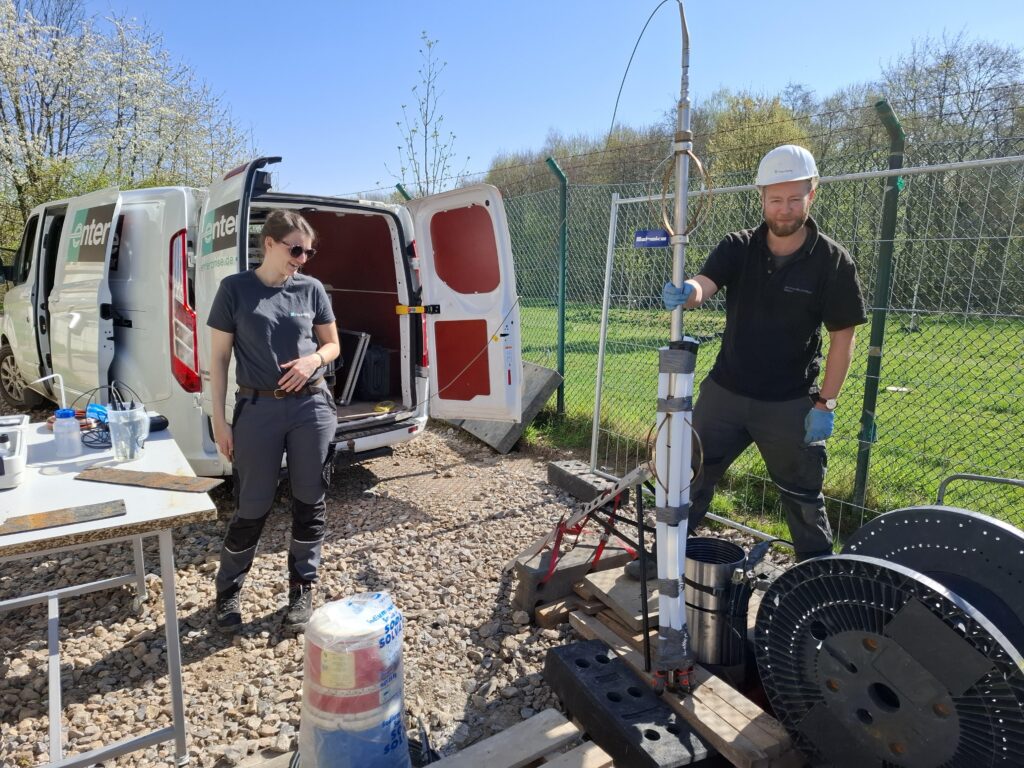
Elke recording water parameters from the Mansfeld flooded colliery at the PUSH-IT drilling site
Why have you chosen this field of science?
I love everything to do with mining! It’s simply my passion. But since there aren’t that many active mines left in Germany, there is a strong focus on post-mining activities. Repurposing old, flooded mines for geothermal heating, cooling or storage is a great idea. I like this concept of sustainability.
What exactly do you research?
I am currently working in the PUSH-IT project, both at the drilling site and also handling public relations for our MTES pilot system. On the one hand, this involves the classic work of a hydrogeologist, such as taking water samples from the old mine that we have drilled into. On the other hand, I also prepare information for the public or professional community, for example as newspaper articles, radio reports, citizen dialogues or at events.
Elke and Stefan Klein sampling mine water from the Mansfeld flooded colliery at the PUSH-IT drilling site
Why is it necessary to do this research?
Using existing infrastructure, in our case flooded mines, is a further building block for the heat transition. However, technology must be tested, for which we have the opportunity to run a pilot system in the project. On the other hand, a wide range of stakeholders need to be involved – good communication and engagement activities are important.
What is the work that needs to be done in the future in this field?
Awareness must be raised that heat storage is possible in various ways and utilising mines is one option.
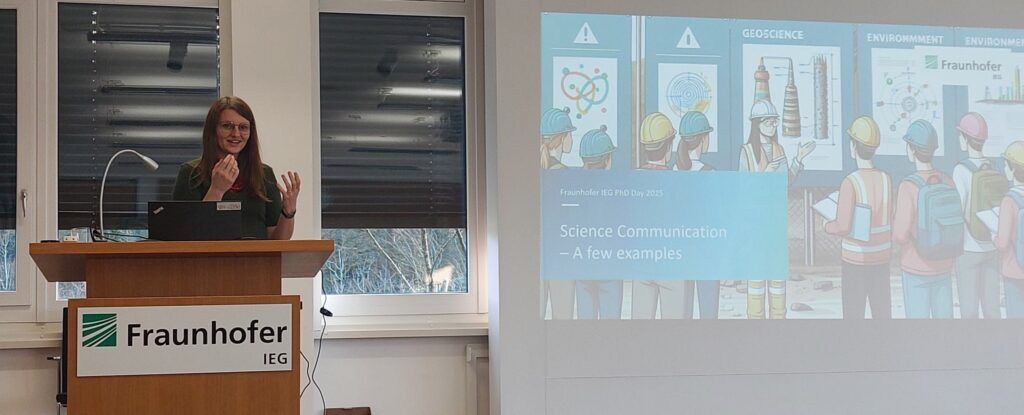
Elke giving a presentation for PhD students about Communication and Engagement activities during the PUSH-IT project
What do you want to accomplish as a scientist?
Although I am a geoscientist, my work also involves a lot of science communication. That’s why it’s important to me to share new ideas and solutions with the public and encourage people to think for themselves.
Do you have any tips for people who want to become as scientist like you?
With passion and enthusiasm for a subject, you can go far and reach others.
PUSH-IT is a project funded by the European Union’s Horizon Europe research and innovation programme under grant agreement No 101096566. Funded by the European Union. Views and opinions expressed are however those of the author(s) only and do not necessarily reflect those of the European Union. Neither the European Union nor the granting authority can be held responsible for them.