
Hot Push Pull Test finished at Berlin Adlershof: a closer look at Hot Push Pull Tests
One of the Enabling Technologies that is being developed by the Push-It project is the Hot Push Pull Test (HPPT). This test should give an insight in the effect that (HT-)ATES has on thermohydraulic storage behaviour, aquifer chemistry, microbiology and fluid-rock interactions. That is all well and good, but how does it work? What are the challenges the team is facing? From July until this month, HPPT‘s have been performed at the site in Berlin. We asked site lead Katrin Kieling what an HPPT is exactly and why it is performed.
What is a Hot Push Pull Test exactly?
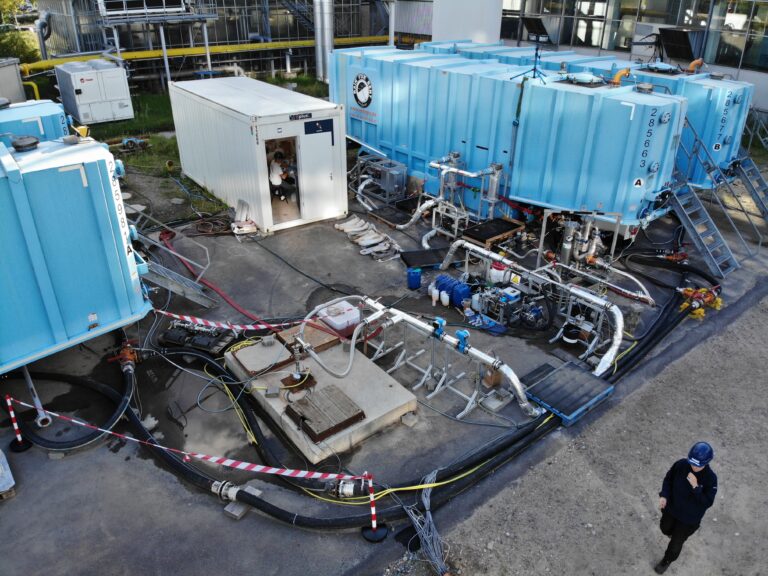
During the first phase of the HPPT we produce approximately 240 m³ of water from the sandstone aquifer in 371-389 m depth and measure the initial fluid chemistry and microbiology. This water is stored on the site in water tanks. In the next phase, the first Push, we add a tracer to the water, that is an inert chemical that we can measure, and heat up the water to the target temperature of 90°C before we inject it through the borehole to the aquifer. We leave the hot water in the aquifer for 24 h and then back-produce it – this is the first Pull. During back-production, we measure the temperature of the fluid, the chemistry and the amount of tracer that is produced back again. The Push and Pull procedure with all their measurements are repeated 4 times. After the last Push, we increase the waiting time to 30 days, before we back-produce the water for the last time and take another sample for microbiological studies.
What is needed to perform an HPPT?
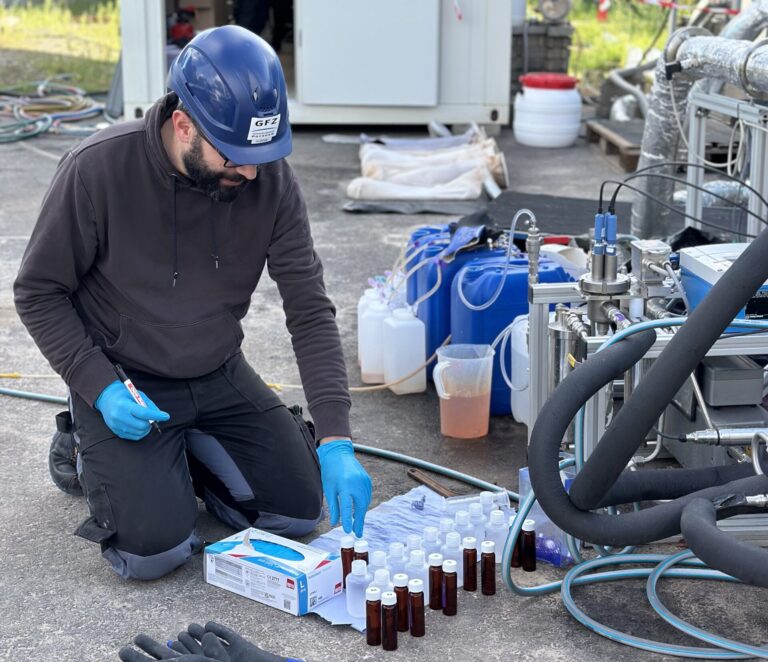
To start we need one completed borehole to our aquifer. Additionally, we need a production pump, tanks to store the water, a heat exchanger to heat up the water, a heat supply that we receive from the district heating system of BTB, a dosing pump to fine tune the injection of the tracer, lots of flow-meters, valves and hoses suitable for hot fluid to regulate the flow, measurement devices to measure temperature, pressure, fluid physical and fluid chemical parameters in flow through, filters to filter out any precipitates or fine particles from the reservoir. Furthermore, equipment for fluid sampling and a fluorometer to measure the tracer. Finally, there is some equipment for regulating and shutting down everything in case of an emergency. And, most important, we need man- and womanpower to perform the test, the measurements and adapt the testing procedure according to the measurements.
How does this test help in developing the ATES system in Berlin?
The HPPT is an aquifer storage test at very small scale. It informs us how the storage will behave and which processes might occur:
- We test how the storage is heating up in multiple cycles. This informs us about the heat storage behaviour and will provide some indications how the performance of the storage will increase with the number of storage cycles.
- We test how the fluid chemistry is influenced by the change in temperature. Change in temperature could lead to precipitation of certain minerals (like the precipitates forming in your water kettle when heating up) that can influence the storage performance, for example, the permeability of the reservoir.
- We test how changes in temperature influence the microbiology. Changes in temperature can influence which microbes are living and thriving in the fluid. Those microbes could form biofilms that again influence the permeability of the storage. On the other hand, they can themselves “eat” or produce certain chemicals that then change the chemical balance of the fluid and might induce precipitation or corrosion.
Prior knowledge of these processes helps us to better prepare the ATES wells by either adapting the borehole design and completion or adapting the operation mode. Sometimes a temperature difference of just a few degrees can make a difference and could lead to longer and better storage performance. It also helps to adjust the surface facilities to the expected performance of the ATES.

PUSH-IT is a project funded by the European Union’s Horizon Europe research and innovation programme under grant agreement No 101096566.
Funded by the European Union. Views and opinions expressed are however those of the author(s) only and do not necessarily reflect those of the European Union. Neither the European Union nor the granting authority can be held responsible for them.