PUSH-IT Round Tables: Engaging Stakeholders to Shape Viable UTES Solutions
In the coming months, PUSH-IT will organise a series of professional stakeholder round tables across its six pilot sites. These interactive sessions are designed to gather insights, drivers, and concerns from the organisations that play a key role in making Underground Thermal Energy Storage (UTES) a successful part of Europe’s future energy system. Serge Santoo leads PUSH-IT’s Work Package for Dissemination, Exploitation and Communication and tells about the scope and goals of these round tables. We asked him a few questions about those round tables.
What are the round tables and what is their goal?
The round tables are focused dialogue sessions bringing together a dozen selected stakeholders who are directly involved in, influencing, or affected by UTES deployment. Their purpose is to explore the practical, economic and organisational conditions required to successfully implement UTES in real-life settings. The goal is not only to exchange perspectives, but to identify what is needed to create viable and scalable UTES business models that work for both the market and society.
Serge Santoo
Who are the stakeholders?
We invite a balanced group of energy-sector professionals, including municipal and regional authorities, district heating network operators, energy utilities and commercial project developers. These are “warm” stakeholders, that organisations already linked to UTES projects or energy system transformation—ensuring the conversation is practical, relevant, and impact-oriented.
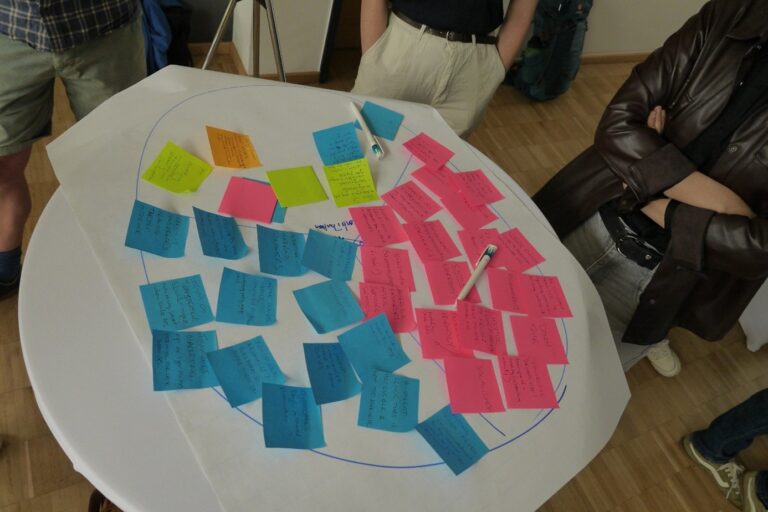
A post it session at a round table
What will be done with the results?
Insights from all six pilots will be analysed and synthesised. We expect site-specific recommendations for UTES business case development. A cross-country comparative report identifying common barriers and enablers will also be written. Lastly, a business plan including market recommendations to support UTES rollout across Europe will be made. The outcomes will directly feed into the project’s exploitation strategy.
How does this support PUSH-IT’s mission and goals?
PUSH-IT aims to demonstrate the value of UTES as a core building block in a resilient, low-carbon and affordable energy system. For UTES to succeed, it must be technically feasible, economically viable, and socially accepted. In this project and through-out my career so far my personal mission is to accelerate a fair and just energy transition—one that works for society, not just the system. These round tables help ensure UTES is developed with stakeholders, not for them, creating solutions that are both trusted and embraced.
PUSH-IT is a project funded by the European Union’s Horizon Europe research and innovation programme under grant agreement No 101096566. Funded by the European Union. Views and opinions expressed are however those of the author(s) only and do not necessarily reflect those of the European Union. Neither the European Union nor the granting authority can be held responsible for them.